Packing and storage tips before move-in day
How to choose a facility, box things properly and stack a unit so nothing is crushed, soaked or lost — put together from what we see go wrong at the units in Kalispell, MT.
Points to consider when choosing a self-storage facility
Worth checking wherever you rent, here or anywhere else.
- Adequate security measures and accessibility
- Unit sizes offered — the possibility of increasing or decreasing the space you need
- Amount of privacy offered, especially if you are storing valuable items
- Adequate climate control, particularly for storage of upholstered items, archive documents or business goods
- Cleanliness and maintenance of the facility
- Pest control measures taken
- Possible surprises in the fine print of the contract
- Adequate access for the removal vehicle you plan to use, if you are storing a large amount
The core packing method
In order to be able to find things quickly and easily at a later date, make an inventory of what you pack and where you put it as you go along. Make an estimate of the replacement value of items you pack for accurate insurance information and in case of damage in the storage facility. Invest in sturdy boxes, and box everything you can to keep your belongings clean and safe. Using boxes of uniform size will save space in the unit and make it easier to stack them securely. Fill boxes to capacity whenever possible, packing heavier items on the bottom and lighter ones on top, and filling empty spaces with packing material to prevent breakage. Label all boxes clearly on more than one side, marking “Fragile” any boxes that contain breakable items. Be sure to seal all boxes with tape before storing them; this will help to keep dust out of the contents and make the boxes stronger. Don’t pack items in sealed plastic bags, as humidity can cause mildew. Pack books flat to protect their spines.
How a well-packed unit is stacked
-
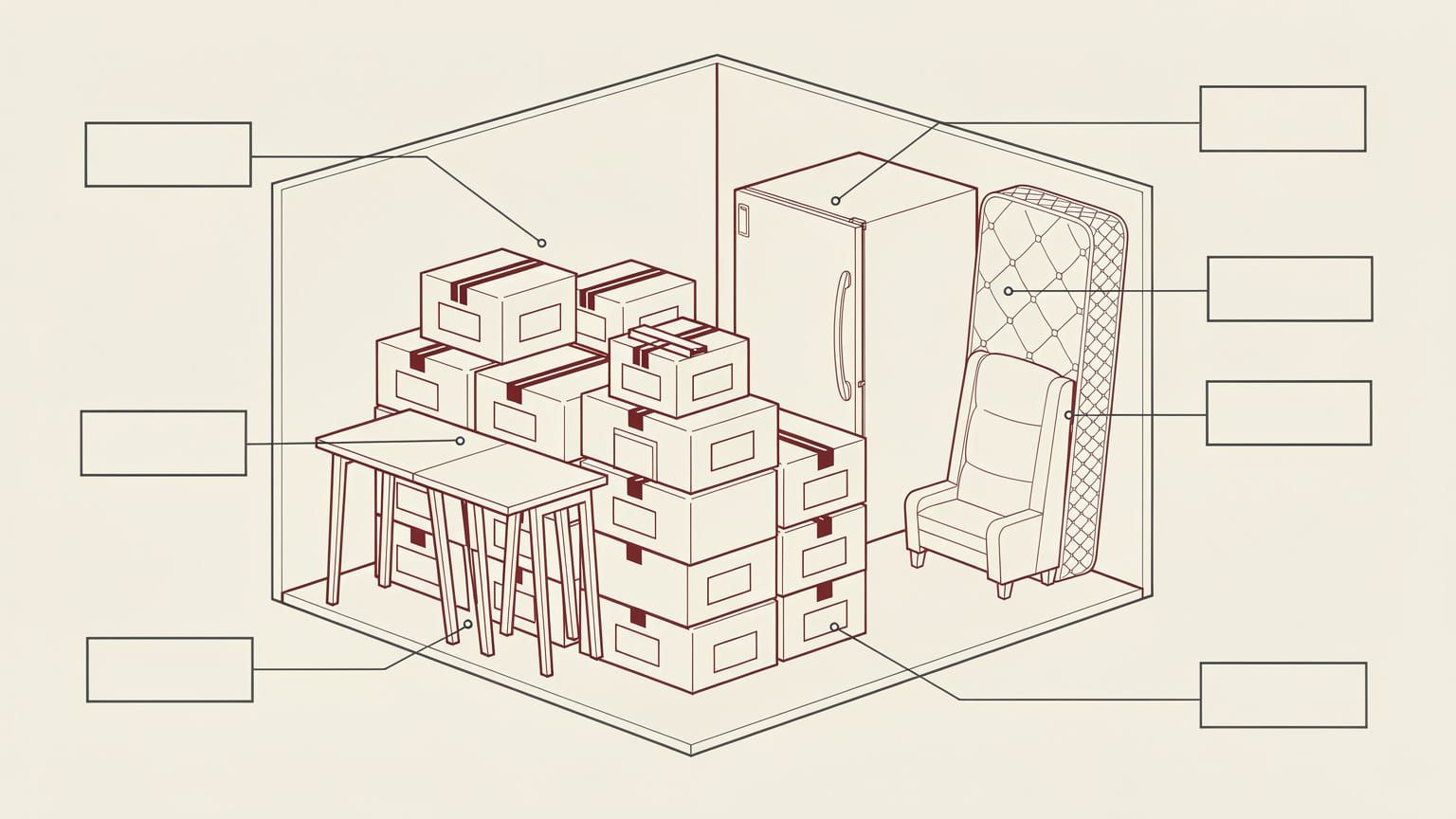
Heavy uniform boxes low, light and fragile boxes on top, soft furniture on end against the wall, appliance doors propped ajar.
Packing this weekend? Book the unit first
It is easier to pack when you know the footprint you are packing for. Call and we will tell you which sizes are open.
Category by category
Different things fail in different ways in storage. Handle each of these on its own terms.
-
Large appliances
Large appliances must be clean and dry before storage; defrost refrigerators and freezers thoroughly, and drain water from washing machines. Wipe insides of appliances with baking soda before storage. Store refrigerators and freezers with doors slightly ajar to prevent condensation, mold or bad odors from forming.
-
Furniture
To save space, dismantle large pieces of furniture such as beds or tables. Wrap and cover furniture sections and keep them together, clearly marked. Put screws and bolts in plastic bags, also marked, and tape them to the relevant piece of furniture for easy retrieval and re-assembly. Store large pieces of furniture vertically to save space. To save even more space, store small boxes in anything that’s hollow, such as furniture drawers, wardrobes, and kitchen appliances like stoves and refrigerators. Stack chairs seat to seat, wrapping the legs for extra protection, and spray any wood furniture with a good furniture spray before storage.
-
Sofas and mattresses
Upholstered furniture such as sofas or mattresses should be covered with bags, sheeting or covers. Stand sofas and mattresses on end to save space whenever possible, and try not to stack too much on top of these soft items. If you stack several pieces of furniture on top of each other, protect them from scratching or damage by placing a dust sheet or cover between them.
-
Fragile items, mirrors and lamps
Wrap all fragile or breakable items separately in paper or bubble wrap, then pack tightly into strong boxes, filling all spaces with filler such as paper or Styrofoam peanuts. When stacking boxes in the storage facility, stack these boxes on top of the heavier ones. Mirrors and pictures should always be stored on end, never flat, and should be wrapped with a protective covering such as bubble wrap and marked as “Fragile.” Lamp bases and shades should be separated and wrapped for protection.
-
Clothing
Clothing is best stored in wardrobe or clothes boxes, where items can be hung up and will keep their shape. Storing clothing in bin liners invites the possibility of moisture being trapped inside and ruining your clothes.
-
Electronics
Electrical equipment such as TVs, computers, and stereos should be packed in their original boxes if possible, or at least in boxes that are about the right size and have any gaps filled in with paper or other packing material.
-
Tools and metal items
Tools and metal items should be rubbed down with oil before storage to prevent rust. Tools can be tied into bundles for storage. Never store brooms or brushes on their bristles, as this will damage them. Remove bags before storing vacuum cleaners.
-
Photographs and archive documents
Photographs or archive documents are not recommended for self-storage, as they are easily damaged due to temperature changes unless the facility is climate-controlled. If you choose to store loose photographs, they should be stored flat between pieces of cardboard that are taped together to prevent curling.
Hard rules and warnings
The short list of things that are not a matter of preference.
- Any items with fuel tanks, such as cars and lawn mowers, must have their fuel tanks emptied before storage. Fuel CANNOT be stored in a self-storage facility.
- Don’t pack items in sealed plastic bags, as humidity can cause mildew.
- Never store clothing in bin liners — trapped moisture will ruin it. Use wardrobe or clothes boxes instead.
- Never store mirrors or pictures flat. They go on end, wrapped, and marked “Fragile.”
- Refrigerators and freezers go in defrosted, dry, and with the doors slightly ajar.
- Never store brooms or brushes on their bristles, and remove bags before storing vacuum cleaners.
- Do not stack heavy boxes on top of sofas, mattresses or other soft upholstered items.
- Photographs and archive documents are not recommended for self-storage because temperature changes damage them easily.
- Seal every box with tape and label it on more than one side before it goes in the unit.
Recurring packing questions
Can I store a car, a mower or a generator in a unit?
Any items with fuel tanks, such as cars and lawn mowers, must have their fuel tanks emptied before storage. Fuel CANNOT be stored in a self-storage facility. Call 406-890-1963 to talk about which size fits what you are parking.
Why does box size matter so much?
Using boxes of uniform size will save space in the unit and make it easier to stack them securely. Fill each one to capacity, heavy items on the bottom, lighter ones on top, gaps filled with packing material.
Should I wrap things in plastic to keep them dry?
Don’t pack items in sealed plastic bags, as humidity can cause mildew. Use bags, sheeting or proper covers over upholstered furniture instead, and boxes for everything that will fit in one.
How do I keep track of what I put in there?
Make an inventory of what you pack and where you put it as you go along, and estimate the replacement value of the items for insurance purposes.
How do I stop tools rusting over a Montana winter?
Tools and metal items should be rubbed down with oil before storage to prevent rust, and tools can be tied into bundles.
What size unit do I need for all of this?
The size guide on the prices page lists what fits in each footprint, from a 5 x 10 at $55.00 up to a 10 x 30 at $140.00.
From planning to loading
Once the boxes are packed, all that is left is a code and a door. Call to reserve the size you need in Kalispell.